

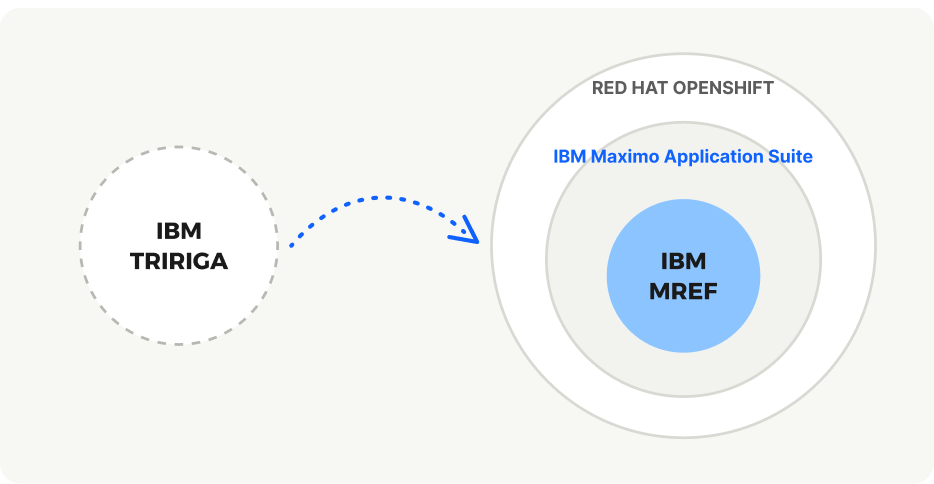
For many years, IBM TRIRIGA has been a leading system for corporate real estate and workplace management. IBM has now evolved it into IBM Maximo Real Estate and Facilities (MREF), part of the IBM Maximo Application Suite (MAS). An IBM TRIRIGA to IBM MREF migration is more than a simple version update: it moves your system onto a containerized platform running on Red Hat OpenShift.
Because IBM support for all versions of IBM TRIRIGA and IBM TRIRIGA Application Suite ends on September 30, 2027, and software sales have already concluded, organizations must proactively assess their migration plans. This guide provides a complete roadmap covering platform readiness, data and customization migration, CAD/BIM floor plan preparation, licensing, and key risk mitigation strategies.
Understanding key milestones is critical for establishing a secure, fully supported transition path without operational disruption.
IBM TRIRIGA software ordering ended, including new SaaS orders.
Base support ends for the specified IBM TRIRIGA versions and components covered by IBM's lifecycle announcement. Sustained Support options apply to eligible products.
Deadline to complete the transition to Maximo Real Estate and Facilities to remain eligible for IBM's announced dual-support arrangement.
IBM MREF keeps the core lease, space, project, and maintenance capabilities you use today while introducing the modern features and governance of the Maximo Application Suite.

After September 30, 2027, IBM TRIRIGA will shift to IBM Sustained Support—a limited tier without new security patches or features. All future functionality and innovation are built exclusively for IBM MREF.

IBM MREF runs in the same suite as other Maximo applications, allowing real estate, facilities, and asset maintenance teams to share data, workflows, and single sign-on rather than operating in silos.

IBM MREF runs on containerized Red Hat OpenShift. This architecture supports flexible deployment models—including IBM-managed SaaS, dedicated cloud, or on-premises infrastructure—and simplifies ongoing updates.

Existing IBM TRIRIGA licenses transition to MAS AppPoints. AppPoints operate as a shared pool of licensing credits that can be dynamically allocated across IBM MREF and other applications in the suite.

IBM MREF integrates advanced capabilities, such as AI-driven lease abstraction, IoT sensor integration, and Wi-Fi occupancy tracking to deliver real-time insights into actual space utilization.
Before initiating the migration, perform a comprehensive review of your existing environment to define scope, effort, and technical risks.

Inventory custom classes, custom tasks, workflows, reports, and non-standard database adjustments. Determine which customizations can be eliminated in favor of standard IBM MREF features.

Document every connection to external enterprise systems, including ERP/Finance (SAP, Oracle, Workday), HR platforms, middleware, and single sign-on services.

Confirm your active IBM TRIRIGA version and map your cutover schedule relative to the September 30, 2027 base support deadline to reserve sufficient time for testing and training.

Estimate total AppPoints requirements and decide on your deployment strategy (IBM-managed SaaS, dedicated managed cloud, or customer-hosted infrastructure).
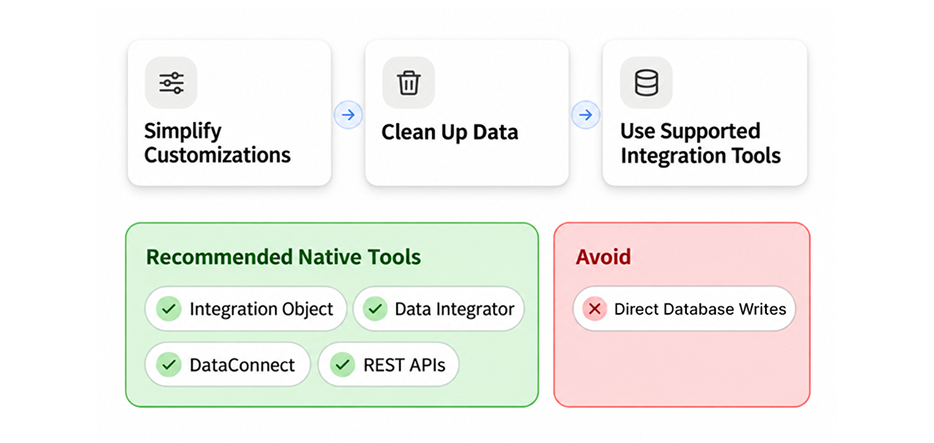
A successful technical transition prioritizes reducing technical debt and utilizing supported API channels.
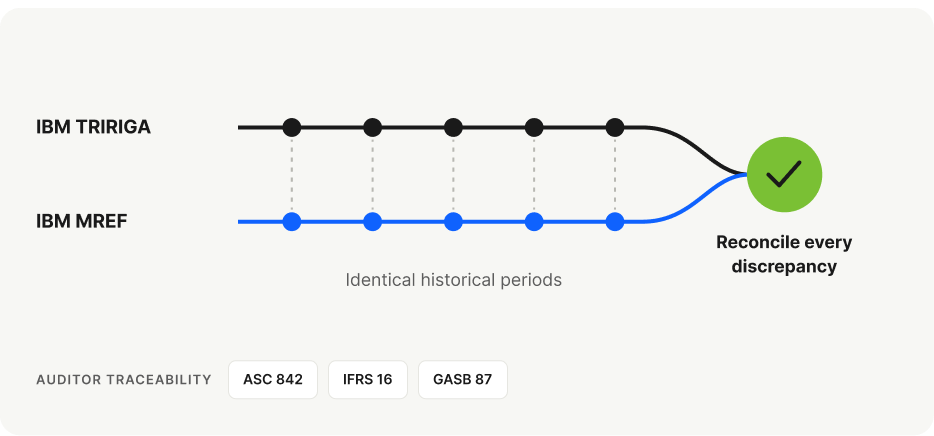
Lease records demand high precision during migration because they directly impact financial reporting and regulatory compliance.
Space management performance depends on clean, standardized spatial data before loading floor plans into IBM MREF.
Ensure DWG drawings strictly follow consistent layer conventions for gross and net assignable areas (e.g., A-AREA-GROS and A-AREA-NSFT).
Normalize room classification codes (such as BOMA or FICM standards) across all global sites prior to ingestion.
If using Autodesk Revit, verify model completeness and integrity so IBM MREF's BIM integration can automatically instantiate accurate building, floor, space, and asset records.
Quantum Strides is an IBM partner specializing in IBM TRIRIGA and IBM MREF implementation, migration, and ongoing platform support.

We conduct an in-depth review of your current IBM TRIRIGA environment, evaluating system architecture, dependencies, risks, scope, and estimated effort to build your deployment roadmap.

Our health check service evaluates custom tasks, Java objects, and workflows to identify redundant code, guiding your system back toward standard capabilities to simplify future updates.

We oversee complete data cleansing, extraction, and financial reconciliation—including parallel accounting runs to safeguard historical audit trails under ASC 842 and IFRS 16.

Our specialists review floor plan drawings, normalize location hierarchies, and clean BIM/CAD layer structures for seamless IBM MREF space management ingestion.

With certified IBM TRIRIGA/IBM MREF testing teams, we design and execute SIT, UAT, security, and performance test suites to validate workflows, interfaces, and migration outputs.

We manage cutover activities, delta data loads, production transition, and hypercare support to ensure operational stability and fast issue resolution.
Early planning ensures a seamless transition to Maximo Real Estate and Facilities. Initiating a migration assessment today gives you complete control over your scope, timeline, risk management, and licensing structure—ensuring your platform remains fully supported, secure, and ready for future growth long before end-of-support deadlines arrive.
Contact Quantum Strides today to book your IBM TRIRIGA Migration Assessment.
IBM base support for all versions of IBM TRIRIGA and IBM TRIRIGA Application Suite ends on September 30, 2027. Afterward, eligible products move to IBM Sustained Support, a limited support tier.
No. Software ordering for IBM TRIRIGA and IBM TRIRIGA Application Suite ended on January 28, 2026.
IBM TRIRIGA was a standalone real estate management platform. IBM MREF is built on Red Hat OpenShift as a native component of the IBM Maximo Application Suite (MAS), offering shared licensing, advanced AI tools, and unified asset and facilities management.
It is a migration. Because IBM MREF runs on containerized Red Hat OpenShift within MAS, the process involves migrating data, re-platforming configurations, and re-validating integrations.
Yes, IBM MREF supports IBM TRIRIGA-style workflows, custom tasks, and Java class loaders. However, reviewing and replacing customizations with native IBM MREF features is recommended to lower future maintenance overhead.
Historical lease payments, GL entries, and audit trails are migrated into IBM MREF. Parallel accounting runs are performed during testing to verify that financial figures match prior-period results under ASC 842 / IFRS 16.
Existing IBM TRIRIGA licenses transition to MAS AppPoints. AppPoints are drawn from a shared, flexible pool of licensing credits shared across IBM MREF and other MAS applications.
Yes. Running on Red Hat OpenShift, IBM MREF can be deployed in IBM-managed SaaS, public or private cloud environments, or on-premises infrastructure.
Timelines depend on customization depth, number of integrations, and data integrity. A discovery and assessment phase provides a tailored timeline based on your environment.
Primary risks include unverified lease accounting figures, poor data integrity, and unrationalized legacy customizations. These are managed through structured discovery, parallel testing, and CAD standardization.
Downtime is minimized by completing data cleansing ahead of time, pre-loading historical datasets prior to cutover week, and staging a strict delta migration plan.
Start with a migration readiness assessment to inventory your current IBM TRIRIGA customizations, audit integrations, estimate required AppPoints, and build an actionable roadmap well ahead of support deadlines.