

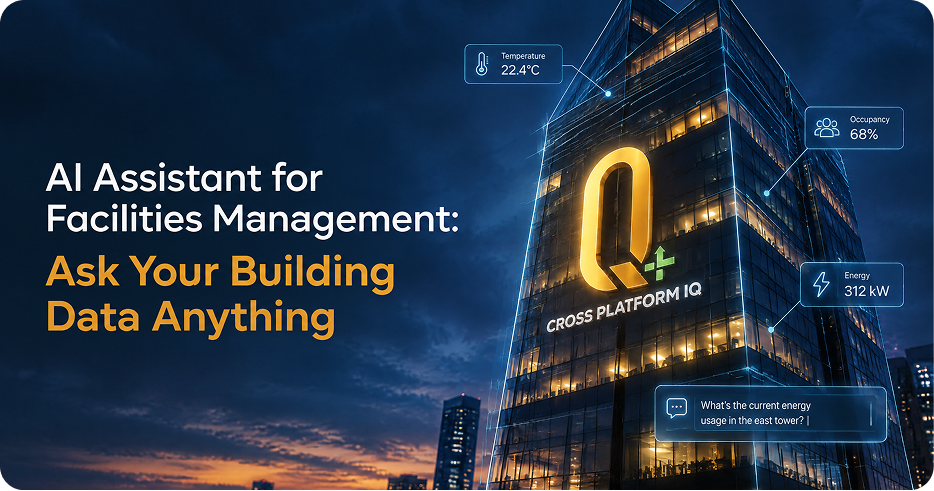
At 7:40 a.m., Maya, a facilities director overseeing three campuses and 60 buildings, needs to identify which properties should receive capital investment this year. Her CFO expects a recommendation at 10:00. The information exists across her integrated workplace management system (IWMS), computerized maintenance management system (CMMS), lease records and building condition assessments—but bringing it together could take days.
An AI assistant for facilities management can help teams query these disconnected data sources through natural language, including voice, and retrieve answers with source context. Instead of waiting for another spreadsheet, facility leaders can explore building conditions, maintenance priorities and lease decisions from a single conversational interface.
Maya is a composite drawn from common facilities scenarios, not a specific customer. Figures in her story are illustrative.
Enterprise facility teams aren’t short of data. They’re short of a way to ask it questions. Space lives in the IWMS, work orders in a CMMS, leases in spreadsheets, and condition findings in last year’s assessment report.
The last time Maya needed a cross-system answer, it took two days: an analyst, three exports and a pivot table. By the time the numbers arrived, they were already stale.
She isn’t alone. Most enterprise real estate teams struggle to get expected results from disconnected systems, and very few have access to real-time business intelligence across their portfolio. Meanwhile, capital renewal and maintenance backlogs continue to climb. Teams that want to reduce work order backlog with AI first need to see that backlog clearly, across every system at once.
Table: How facility teams get cross-system answers today, and with an AI assistant
| Traditional cross-system reporting | Conversational AI assistant | |
|---|---|---|
| Time to answer | Days: an analyst, several exports and a pivot table |
Seconds for supported questions, asked in plain language
|
| Who can ask | Specialists who know each system, report builder and table name |
Any permitted user, by voice or text
|
| Where questions happen | At a desk, after the walkthrough or meeting |
On web or mobile, on site, in the plant room or in the meeting
|
| Follow-up questions | A new report request and another wait |
Refined in the same conversation
|
| Data freshness | Often stale by the time the report arrives |
Each answer shows when the data last synced
|
| Traceability | Depends on spreadsheet notes and memory |
Each answer names its source data
|
| Impact on existing systems | Unchanged, but data stays siloed |
Unchanged; the assistant sits on top as an access layer
|
The real cost isn’t the slow report. It’s the question that never gets asked because answering it takes too long.
Maya’s morning starts before she asks anything. Her 6:00 a.m. Smart Schedule report is already in her inbox, listing overnight high-priority work orders. Then she opens Q+ Cross Platform IQ on her phone and speaks.
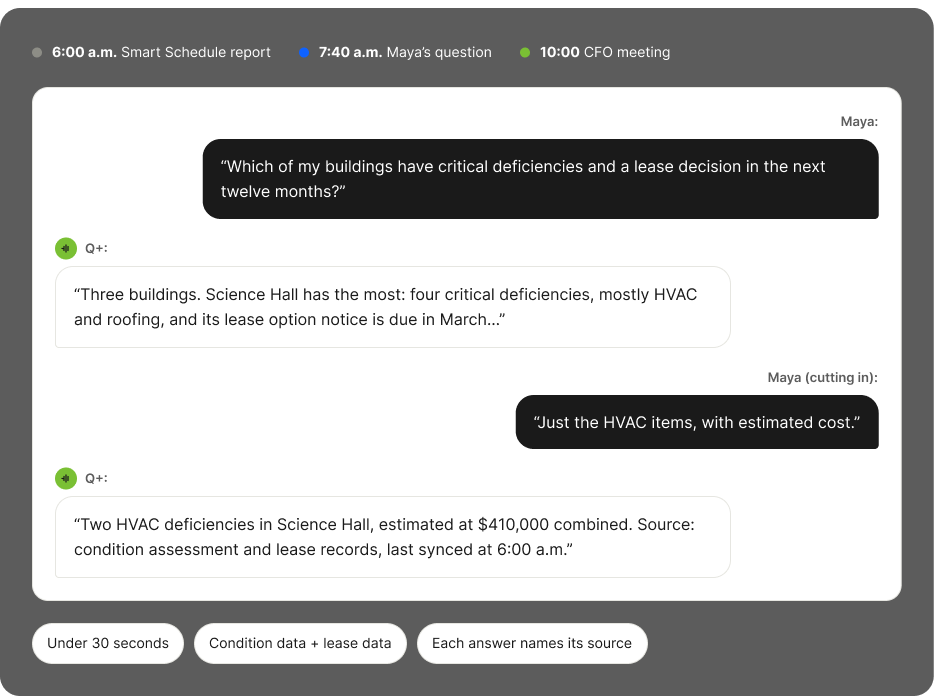
In under 30 seconds, that exchange combined condition data with lease data, two modules that normally live in separate systems. Maya interrupted mid-answer and Q+ adjusted immediately. The spoken answers stayed short, and each one named its source.
This is what a facility management AI assistant should feel like: a conversation, not a report request. Facility leaders are rarely at a desk. Questions come up on walkthroughs, in plant rooms and in tenant meetings, which is exactly where voice helps most.
Nothing in Maya’s story was replaced. Q+ works as an AI assistant that sits on top of the IWMS, CMMS and other systems a team already runs. Data flows in through APIs, JSON or CSV and maps to one facilities data model covering portfolio, space, operations and maintenance, inventory, lease and condition assessment.
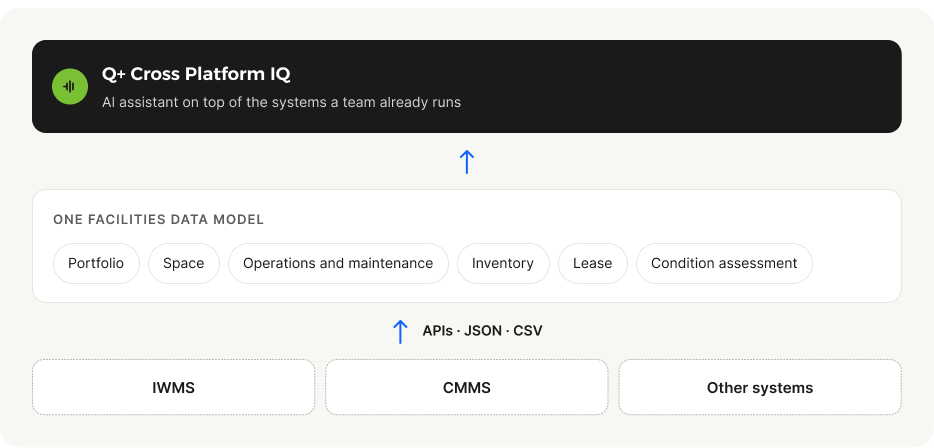
That matters because replacement is the slow road. Large-scale system replacements routinely run over budget, take years to deploy, and deliver less value than predicted.
An intelligence layer avoids that risk. There is no migration of the system of record. Existing licenses, configurations and trained users keep their value. Teams can start with core portfolio data and add modules as they go, measuring onboarding in weeks, not years.
In the 10:00 meeting, the CFO asks for a follow-up nobody prepared for. Maya asks Q+ in the room, then opens the source panel to show where the number came from.
Trust is the biggest hurdle for any enterprise facility management AI chatbot, with data quality and security topping the list of adoption barriers for FM leaders. Q+ addresses that in four ways:

Source attribution: every answer names the database or file, the tables used and the number of data points checked.

Freshness timestamp: the screen shows when data last synced, so decisions rest on the latest synced data.

Access control: role, geography and organization-based permissions, with Active Directory and Okta sign in.

Security and hosting: SOC 2 Type 1 certified, Type 2 in progress, with a customer owned hosting option.
Conversational access to facility data is moving from experiment to expectation. Real estate teams are rapidly shifting from early AI pilots to active deployment, and enterprise applications are increasingly embedding task-specific AI agents into daily workflows.
The workforce is changing too. As a large share of experienced facilities managers near retirement, plain-language questions let a new coordinator get answers from week one, with no report builder or table names to learn.
Our view at Quantum Strides: within a few budget cycles, facility teams will expect to ask their data questions out loud.
See Q+ answer questions on a portfolio like yours:
Yes. An AI assistant can integrate with an existing IWMS when the necessary APIs, data exports or connectors are supported. This can provide a conversational access layer while the original system remains the system of record.
Yes. A voice-enabled facilities management assistant lets users ask natural-language questions about supported building, maintenance, lease and condition data. Available functions depend on the product’s integrations and permissions.
AI can help bring together building condition assessments, maintenance histories, lease milestones and portfolio data to identify potential priorities for further review. Final investment decisions should be validated against source records and organizational criteria.
Enterprise controls can include authentication, role-based access, encryption and auditability. Organizations should verify the specific controls, certifications and hosting arrangements offered by their chosen solution.